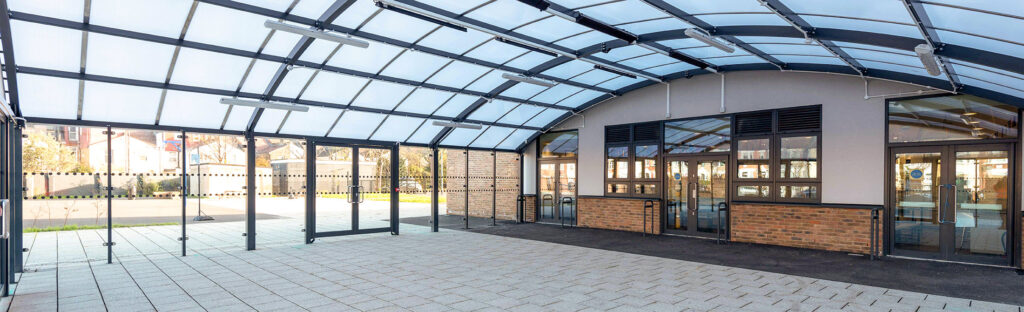
Covering a range of design-types and utilising different materials and construction techniques, the motivation behind a school canopy project can be driven by a particular purpose, or simply to enhance the built environment with a stylish new structure. Certain canopy designs are better suited to particular functions, and while all types of canopies provide shelter from the elements, enclosed canopies take the flexibility of these structures and combine them with a range of options to help create cost-effective, fully weather-protected spaces.
What Are the Benefits of Enclosed Canopies?
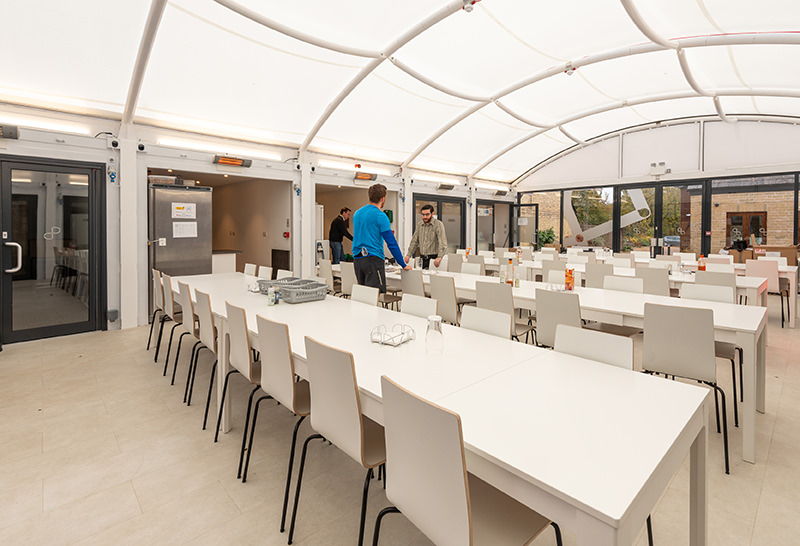
For certain use-types, such as additional dining and social space, enclosed canopies can provide opportunities to utilise available and potentially under-utilised external space, incorporating appropriate lighting, heating, and enclosure systems to ensure staff and students remain dry and comfortable.
Various lighting solutions and the ability to provide warmth to staff and students in colder weather, enables effective year-round use and a bright environment no matter the weather.
These additions also increase the versatility of the space, extending potential use into the evenings for extra-curricular activities and local community events. Partially enclosed canopies can also help create free-flow learning and playground areas for early years pupils.
What Are the Design Considerations for an Enclosed Canopy?
Polycarbonate or Fabric?
- Polycarbonate Roof Enclosed Canopies offer a cost-effective solution for creating flexible covered spaces ideal for a variety of use-types. They provide flexibility of design, with options for roof designs including symmetric, asymmetric, and mono pitch to accommodate varying site layouts and requirements, while column positions can be adjusted to coordinate with adjacent building design. Polycarbonate roofing offers high levels of light transmission to provide a bright atmosphere within the enclosed space, restricting sunlight glare and absorbing harmful UV rays.
- Fabric Roof Enclosed Canopies are structures with tall central lines that help to create clear span covered space effective for different use-types, while the durable tensile membrane ensures longevity of use for schools. To a greater degree than polycarbonate roof structures, it provides excellent noise absorption qualities, softening the sound of rain, voices and echo. Comprising a unique design form, fabric canopies drawn from characteristics distinct to membrane tension that provides strong light transmission to create a naturally lit, diffused environment, combined with the availability of artificial lighting that helps to provide external luminescence at night.
What About Enclosure Options?
- Toughened Glass Walling – Giving the structure an appealing contemporary feel with high light transmission, toughened glass is highly versatile and up to 7 times stronger than regular glass. This provides the durability to withstand daily wear and tear in busy school environments, while its high impact resistance ensures safety for pupils and staff in use of the space.
- Aluminium Curtain Walling – The key feature of aluminium curtain walling is that it provides excellent energy efficiency to reduce operational costs within the space, acting as an insulator to ensure thermal efficiency in the colder months. In the warmer months, it offers good natural light transmission but restricts the heat of the sun to help create a bright and cool working environment for staff and pupils.
The Streetspace Process
Considering key aspects during the design stage of an enclosed canopy project, such as the specific site conditions and the orientation of the structure, helps to ensure that specifications for roof design, the size of canopy, and the positioning of ventilation gaps, doors, and heaters are able to be adjusted as required, ensuring that internal temperatures fall within the accepted parameters for use during all seasons.
The design and delivery of an enclosed canopy with Streetspace is coordinated as a single works package, which includes liaison with building control, civil engineering works, and surfacing. From survey to manufacture, all school canopy structures from Streetspace are designed to be free-standing, and are developed in-house using the latest 3D CAD technology. This helps to ensure project teams can accommodate challenging site constraints or specific design features with ease.